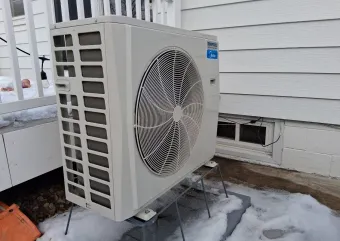
The Schneider family opted to make the transition to an air source heat pump (ASHP) when their previous system, a furnace, began leaking carbon monoxide. As they researched their replacement options, an ASHP came out on top as the most cost-effective option for their home and family.
Home Details
- Built: 1951
- Size: 2,340 square feet
- Utility:
- Electric: Rochester Public Utilities
- Gas: Minnesota Energy Resources
The Schneider Family’s Story
Many residents choose to switch to an air source heat pump (ASHP) for environmental reasons, while others choose electrification for financial, health, or safety reasons. For the Schneiders — Viv, Lee, and their three children — the switch started when they discovered a problem with their heating system. “We had an inspection done on our 20+ year old furnace, and they told us it was leaking carbon monoxide (CO),” said homeowner Viv. “So, we needed to replace it.” Older gas furnaces are more likely to have issues with combustion and venting, which can create health and safety risks.
Knowing they needed to replace the existing system, the Schneiders began to look at their options. They found the cost of a dual-fuel system with an air source heat pump and a backup gas furnace would be lower than the same furnace and a central air conditioning (AC) unit. Viv and Lee took advantage of a $2,000 rebate from Rochester Public Utilities (RPU) and the $2,000 federal Energy Efficiency Home Improvement tax credit (25C) to help bring down the initial cost. “When we factored in bills, long-term costs, and the rebates available, the air source heat pump made sense from a financial standpoint,” Viv said.
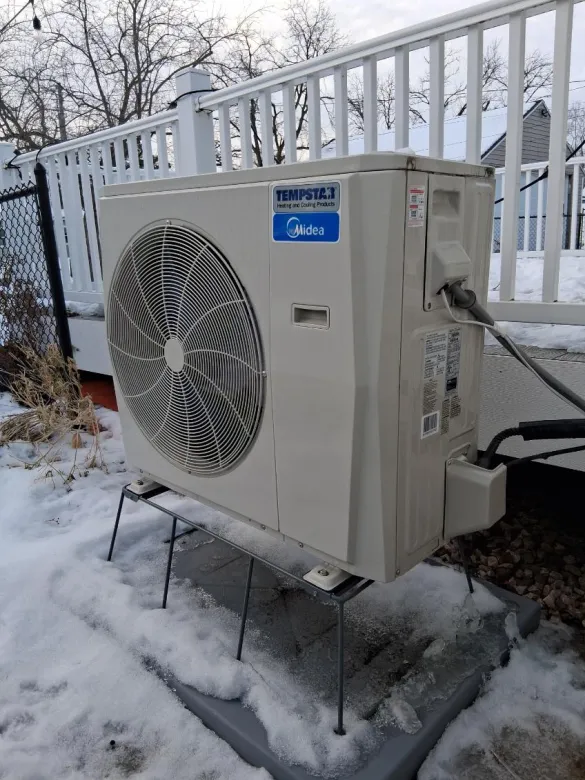
The conversion, however, was not without its headaches. Though the installation went smoothly, the settings on the heat pump valve were arranged incorrectly, causing the system to run in the wrong direction. “When it was really hot outside, our heat pump had one of the temperature gauges switched so when we tried to turn the air conditioner on, it was actually pumping out heat,” Viv said. The issue was easily resolved. “The HVAC company came out and fixed it for us very quickly and easily, no problem. Everything works fine now.”
Without realizing it at the time, the Schneiders had done some pre-work that would later help their heat pump run more efficiently. Not long after buying their home in 2019, the family had insulation installed in the basement and the attic. “These were recommendations from an energy audit,” Viv noted. Weatherization projects like these help heating and cooling systems run more efficiently, because they reduce how hard the system must work to keep the home comfortable, lowering energy costs.
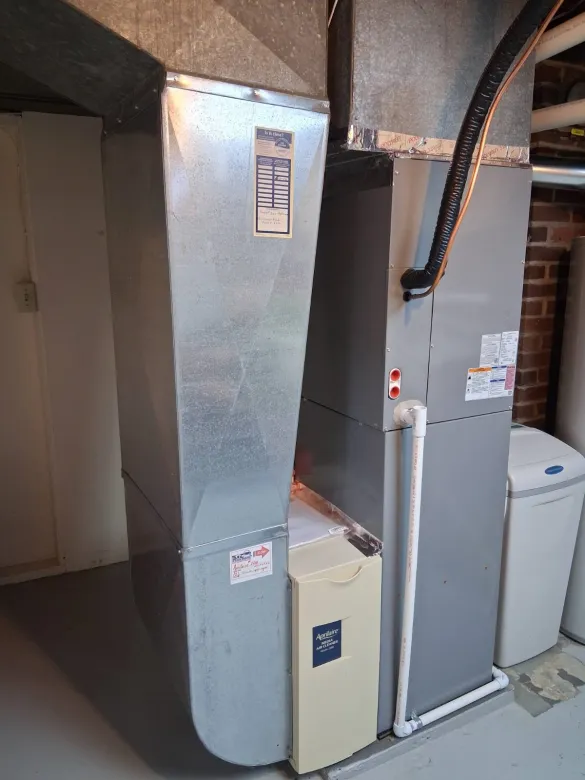
While it may be too early to compare heating bills across seasons, after a cold start to the winter, the Schneiders noted no difference in the comfort of their home, with their heat pump operating smoothly. “In winter, it’s very comfortable. It’ll use the heat pump, and when it gets down to a certain temperature outside, it’ll automatically switch over to the furnace. It’s been no problem when it gets cold.”
Equipment Details
- Air Source Heat Pump
- Size: 2-ton
- Brand: Tempstar
- Model: DLCURA
- Insulation and Air Sealing
- Basement
- Attic
Is an ASHP Right for You?
For many people, an ASHP can heat and cool their home while reducing their carbon footprint. With options for homes with and without ductwork, and for homeowners who want to fully electrify, they offer comfort with flexibility. For more information on ASHPs, review our buyer's guide.